
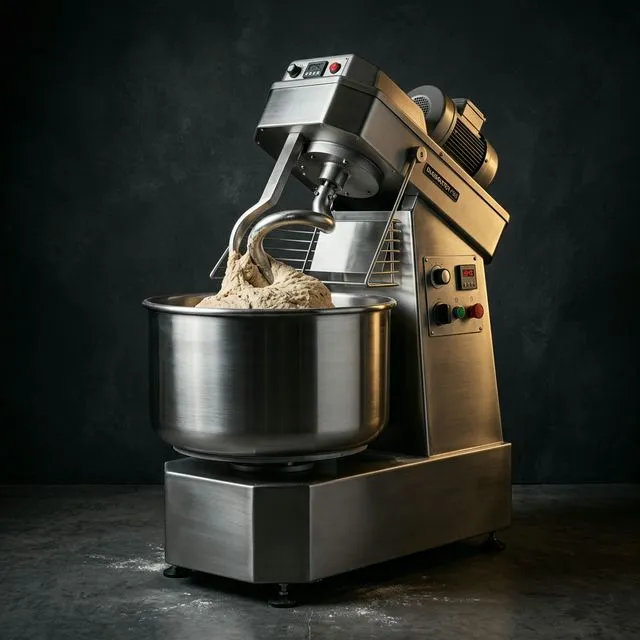
Walk into any commercial kitchen equipment showroom and you'll see rows of mixers that all look roughly the same — a bowl, a motor, some attachments. But underneath the surface, planetary and spiral mixers are fundamentally different machines built for fundamentally different jobs.
Choosing the wrong one doesn't just slow you down. It can ruin your product. Try mixing stiff bread dough in a planetary mixer and you'll burn out the motor. Try whipping meringue in a spiral mixer and you simply can't — it doesn't have a whisk attachment.
This guide breaks down every difference that matters for a working bakery in South Africa, with real rental costs from Golden Rental so you can make the right call without committing to a R50,000+ purchase.
The Core Difference in 30 Seconds
Planetary mixers rotate the attachment (whisk, paddle, or hook) around the bowl while the attachment itself spins — like a planet orbiting the sun. This creates a versatile machine that can mix, whip, cream, and knead.
Spiral mixers keep the attachment stationary while the bowl rotates. The spiral-shaped hook pulls dough from the bottom and folds it over itself. This creates superior gluten development for bread and pizza dough — and nothing else.
Detailed Comparison
| Feature | Planetary Mixer | Spiral Mixer |
|---|---|---|
| Primary use | Cakes, batters, creams, general mixing | Bread dough, pizza dough, bagels |
| Gluten development | Moderate — can knead but less efficient | Excellent — designed specifically for dough |
| Attachments | Whisk, paddle, dough hook (3 included) | Spiral hook only (sometimes 2 speeds) |
| Speed range | 3-10 speeds — from slow fold to high whip | 1-2 speeds — slow kneading only |
| Dough temperature | Tends to heat dough (friction from attachment speed) | Keeps dough cooler (bowl rotation, less friction) |
| Max dough hydration | Handles 55-75% hydration well | Handles 50-85%+ hydration excellently |
| Batch consistency | Good — may need scraping down | Excellent — self-folding action means even mixing |
| Versatility | Very high — one machine for many tasks | Low — dough only |
| Typical capacity | 5L to 80L (commercial) | 20L to 200L+ (commercial) |
| Floor space | Compact — sits on counter | Larger — often floor-standing |
Which Mixer for Which Job?
When to Choose a Planetary Mixer
A planetary mixer is the Swiss Army knife of the bakery. If your business does multiple types of baking — cakes, biscuits, meringues, buttercream, AND some bread — this is your machine.
- Cake bakeries: Whipping eggs, creaming butter and sugar, folding batters — all need the whisk and paddle attachments.
- Pastry shops: Shortcrust, puff pastry prep, fillings, ganaches.
- General bakeries: You do a bit of everything — some bread, some cakes, some pastries. One machine, three jobs.
- Catering kitchens: Mashed potatoes, whipped cream, batter for large batches.
- Small butcheries (with meat hub attachment): The 20L Planetary Mixer with Meat Hub attachment from Golden Rental doubles as a meat mincer — one machine, two businesses.
When to Choose a Spiral Mixer
A spiral mixer does one thing — dough — and does it better than anything else. If bread, rolls, pizza, or bagels are your core product, get a spiral.
- Artisan bread bakeries: High-hydration sourdoughs and ciabattas need the folding action of a spiral.
- Pizza restaurants: Consistent, cool dough batch after batch. Spiral mixers don't overheat the dough.
- High-volume bread production: If you're making 50+ loaves a day, a spiral mixer will pay for itself in consistency and speed.
- Bagel shops: Bagel dough is notoriously stiff (low hydration). A planetary mixer simply can't handle it.
Quick Decision Flowchart
Real Costs: Renting vs Buying in South Africa
Buying a commercial mixer in South Africa is a major capital decision. A new 20L planetary mixer starts at R18,000–R25,000. A 20L spiral mixer? R35,000–R55,000. And that's before delivery, installation, and the electrician to check your 3-phase connection (spiral mixers often need it).
Here's what renting from Golden Rental looks like:
| Equipment | Deposit | Est. Monthly Rate | Power |
|---|---|---|---|
| Planetary Mixer 10L | R2,000 | R1,000 - R1,400 | 220V single-phase |
| Planetary Mixer 20L | R2,500 | R1,200 - R1,700 | 220V single-phase |
| Planetary Mixer 20L + Meat Hub | R3,250 | R1,600 - R2,200 | 220V single-phase |
| Dough Mixer 20L Spiral | R3,500 | R1,700 - R2,400 | 220V single-phase |
⚡ All Golden Rental mixers run on 220V single-phase power. No 3-phase installation needed. Plug it in and start mixing — this is a major advantage for small bakeries, home-based businesses, and anywhere load shedding makes 3-phase unreliable.
Load Shedding & Mixers: What Actually Matters
South African bakeries face a unique challenge: you can't predict when Eskom cuts power mid-knead. Here's what to know:
- Single-phase mixers (all Golden Rental units) restart immediately when power returns — no phase sequencing to worry about.
- Dough in progress during outage: For bread dough, if it's been kneading for more than 50% of its cycle before the outage, it's usually salvageable. For cake batters with chemical leaveners (baking powder), you may need to start over.
- Rental advantage: If a mixer's motor is damaged by a power surge during load shedding, you're covered. Our maintenance team handles repairs — it's not your problem.
The Bottom Line
If you bake mostly bread, pizza, or bagels — spiral mixer. If you bake anything else, or a mix of everything — planetary mixer. If your business does significant volumes of both bread AND cakes, the optimal setup is one of each. With Golden Rental's deposit-only model, you can have both on your floor for less than the purchase price of a single entry-level spiral mixer.
Still unsure? The best way to decide is to start with one and add the other once you know your volumes. Rental terms from 1 to 6 months mean you can switch equipment as your business evolves — no long-term commitment, no depreciation, no maintenance headaches.